Choose this option if you'd like to support this project and join the collective but not necessarily be a participant. This will help us further de... Read more
Starts at
£5GBP
Latest activity by
Be the first one to contribute!
Goal
Participant
LIMITED: 12 LEFT OUT OF 12
This is a participant ticket for the whole pilot! Choose the option that meets your family's ability to pay. 420 is the average we hope to receive ... Read more
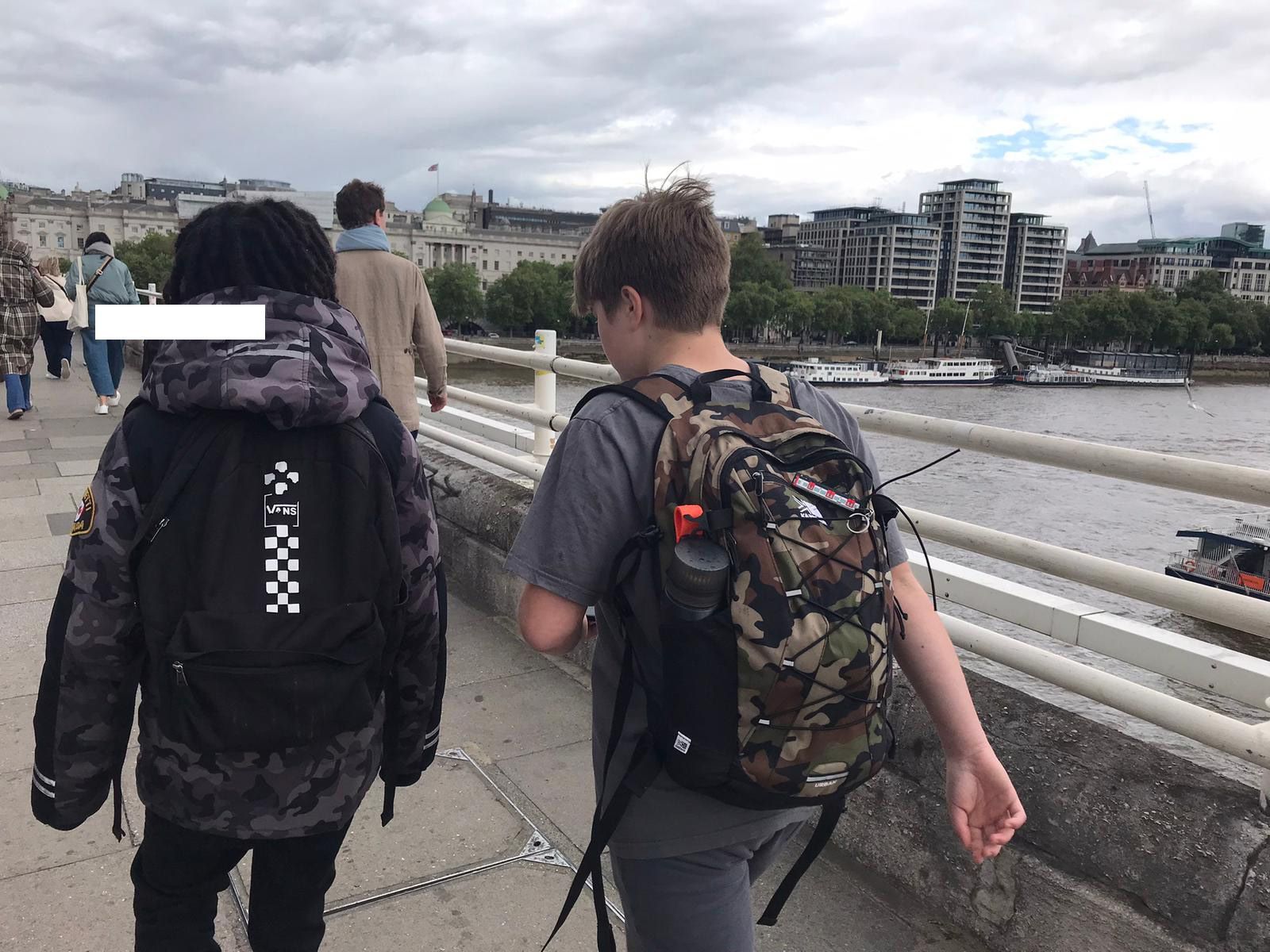
We are midway through pilot 2 of London is Our Campus and we've been to the Elephant and Castel, Greenwich, the South Bank, Chinatown and Whitechapel! We've made nature films, sat around a fire, invented games, explored abandoned buildings...
London as Our Campus is an experimental learning offering exploring how we may, together, learn freely in the city. It has emerged out of years of working within alternative learning communities in London, around the UK and overseas, where communities are in search of ways to learn which are more connected to self, to community and to the land, and to overall wellbeing.
We ran Pilot 1 as part of Free We Grow's Giftival and had 8 awesome participants ranging in age from 11 to 28! We met weekly on Mondays for 8 weeks and our exploits took us to Waterloo, Green Park, Stratford, Battersea and Elephant and Castle - we played, got confident, explored, adventured, ate cookies, talked about deep things, listened, took decisions, had eddies, found our way back to flow, met strangers, got sandy, laughed, enquired, learnt, shared, made friends, got to know London, our kith, a little bit more, and made a zine about it all!
One of the significant findings from Pilot 1 is the beauty of moments. As we live life, we have significant moments. Moments where we come across something new, moments where we have to make a decision, moments where we feel something. Pilot 1 was full of these, and they were different for each participant, and for each facilitator. Each of our learnings took on their own distinct journeys. It felt beautiful to notice that.
This second pilot builds on the first, nourished by feedback from the first cohort of participants, their parents, and in conversations at our closing Biscuit Party on the South Bank, at two public gatherings in the summer of 2025, at Elephant and Castle, and at the Freedom to Learn Forum 2025 at the Beeches in the Lake District.
Dis-enclosure
This project intentionally engages with the need to liberate learning. Learning is a natural process which young people are predisposed towards. However, over the last few centuries it has become more and more enclosed in private spaces and within sets of rigid and hierarchically structured relationships. What is worthy of learning has become more strictly pre-determined, processed, packaged and compared, and the ways in which young people are expected to learn have become more narrow, and removed from the sensory. This has had and is having a marked impact on young people’s wellbeing and on the relationships young people have within their communities and with the land they live on. This project seeks to find ways to heal this separation.
The privatization of land and learning has rendered space for free association and learning much more limited, and yet - we live in London - an incredible Natural Park City, a museum, a peek into the future, a multicultural and multilinguistic hub, a treasure trove of libraries, a sensory extravaganza of tastes, smells, sights, sounds and textures. Part of this project is a mapping of public space so that it may be reclaimed by learners. It is often our preconceptions of where learning is allowed to take place which seems to stop us from exploring the full extent of possibilities of where it could take place. Private spaces can also be used by invitation; this could be by organizations which support this work and offer use of their spaces, or by individuals who have access to spaces. For example, during the first pilot, we visited Infoshop 56a, a radical archive and social center in Elephant and Castle, and we’ll be returning there upon invitation in Pilot 2. The project will actively engage with the question of land rights. Participants will help to shape the questions and enquiries around land and access which can help us move towards a more liberatory learning ecosystem for young people.
Relationships
One of the tenets of this offering is that learning that nourishes happens when people are in healthy relationships with each other, where power and agency are explicit and mutually shared, and where the option of pursuing one’s curiosities is respected, trusted and facilitated. The nature of the relationships that young people have are also part of what and how they learn, and form a bedrock for future associations. As with land rights, the project intends to hold an open and explicit enquiry into the nature of relationships and where power lies, as an attempt to engage with issues of social justice. As such it is also evident that the space has the scope of being a therapeutic space.
As the project unfolds through iterations, it will also inquire into the manner in which the division between learning and work has become more binary and hence also limited the scope within which young people can learn. Throughout history, young people have learnt through play and through learning how to work, via encounters, mujawarat, apprenticeships and work placements. This doesn’t need to start at the age of 18 or 21. Young people interested in any discipline, whether it’s music, art, health, science, may be supported to find placements which can suit their interests. We fore see inviting businesses or individuals with a skill who would like to team up with a young person on their learning journey to join a library of friends who can support the program and mutually benefit from the engagement.
Alivelihoods
Alivelihoods, as introduced to us by friends at Swaraj University, is the term used to to describe meaningful and regenerative livelihoods that are oriented towards social, ecological, and personal wellbeing, which have the ability to:
Make the one pursuing it feel alive, joyful, and content (individual/personal level)
Facilitate localisation, build local economy and create resilient economic and social structures (community level)
Regenerate our planet, showcase resilience to climate crisis, and mitigate global inequities (planet level)
London as Our Campus, as a learning space will be exploring the idea of alivelihoods with young people, working to support participants to imagine, create, pursue and find alivelihoods which meet these criteria.
In doing so, issues of social and environmental justice will be central to the program.
Who this is for
London is our Campus is a multigenerational space initially intended for unschooled teenagers. However, the first pilot showed us that pre-teens as well as post teens are also interested in this offering, and that mixed ages enriches the experience. We welcome enquiries from people from all ages, while safeguarding access for unschooled and out of school teens who are seeking new ways to learn freely and in connection.
London is Our Campus is a multicultural space which celebrates all diversities including diversity of language, ethnicity, styles, gender, religious beliefs and neurodiversity. It is held by three facilitators and we need to make sure we can support participants and upkeep a safe nest for all, so participation is contingent on our collective capacity to do so and we’ll strive to find solutions where specific needs are expressed.
The structure of the offering
Pilot #2 builds on the experience of pilot #1. It follows a similar flow, which worked quite well the first time around. The main difference in the second pilot is longer days, starting at 11:30 and ending at 4:00, and more weeks, moving up from an 8 week cycle to a 10 week cycle.
The pilot will continue to meet on Mondays, starting on Monday the 15th of September, taking a break on Oct 20th and 27th, and ending on December the 1st.
The use of enquiry based learning received positive feedback during the first pilot, so we will continue to use this approach. Our time will be divided into three phases:
The first phase, weeks 1 -3 will involve settling, feeling comfortable in self, with others and in place. This can be done through games and play and through conversations in different configurations as well as time to reflect. We will take time to set our personal intentions for our time together which we’ll revisit in later weeks. During this period we will explore what it means to be in the city, how to be safe, how to travel independently and in a group. This part will also include coming up with group agreements and starting to articular our culture including practicing listening to each other and understanding how to make consent based decisions.
During this period, through engaging with place, we’ll start noticing what we’re curious about and sharing it.
The second phase, weeks 3-7 will involve identifying a topic of interest, a question to enquire into, or a challenge. For example, during the first pilot, the participants because curious about play spaces in London, with a particular interest in how places meet the needs of older children. Within this broad topic, some people looked to design their own playgrounds, others rated existing playgrounds, some researched and shared their favourite playground games, and others fine tuned their enquiries looking into the protocols for feeding birds in public spaces.
We prefer one joint enquiry where participants can take on different aspects of the topic, but depending on the group there may be scope for more individualise enquiries.
Searching into the enquiries will involve engaging with London as a city, with people, places and relationships. The tools which are used for this will be developed and documented as the need for them emerges. There is hence an in-built freedom to create. The word ‘search’ is intentionally used instead of ‘research’, as young people are seekers of knowledge and understanding and will be searching for meaning, rather than the more academic notion of re-searching other people’s work.
The third phase, weeks 8-10 will involve a harvest and celebration. What was learnt? What new questions have come up for you? How does it feel? What was fun? What felt hard? What do I want to share with others about what I learnt?
Harvesting can be private, through journaling or portfolios, it can be creating a piece of artwork, a short film, a magazine; it can even be taking an exam if that feels like the right thing for the learner. During the first pilot the participants were inspired by seeing all the zines at Infoshop 56a and decided to create a zine to share their learnings. In this example, the harvest was collective and everyone contributed to the zine using different forms of expression including film making, audio recordings, comic strips, collage and writing.
This is also a time to reflect on process and revisit intentions.
The final week will be a celebration. This will be designed by the participants and can be public facing as in the first pilot where we had a Biscuit Party in the park, or more private.
Pedagogy
Pedagogy is an interesting term because it puts the onus on the teacher. There are indeed countless learning encounters where one person may have more knowledge and experience, and the interpersonal skills needed to impart their wisdom. However, this project also intends to inquire into how we learn. It is supposed that the onus on learning comes from the individual, and that desire and motivation to learn, is owned by the individual. It also acknowledges that as humans we live in relationships and that having nourishing relationships with people and place shapes our curiosities and desires to learn. The term mujawara, which came up during our time at the Freedom to Learn Forum, is a term that we’ll be exploring during this pilot and is inspired by the work of Moneer Fasheh from Palestine, enquiring into how learning happens through proximity and relationship. Reading materials and examples will be shared in the news section of Open Collective for those interested in further understanding this concept, whether as a participant, parent, or other supporter.
The program takes an ed-positive perspective whereby the interest of the person is trusted. No weight will be placed on one enquiry over the other. All interests are valid, and it’s the process of seeking knowledge/knowing oneself which is valued.
During this pilot we will experiment with having a guiding question when designing enquiries. The guiding question will be decided together with the participants. The purpose of these guiding questions will be to be explicit about engaging with social and ecological justice issues and the quest to identify alivelihoods. An example of a guiding question may be:
How can this inquiry support us in living well, within ourselves, with our communities and on this planet?
Facilitation
Pilot #2 will have 3 facilitators, Rowan Salim, Ayesha Bhatti and Artikal Flex. Facilitators are always a co-enquirer. The invitation is that the enquiry chosen by the facilitator is connected to the participants’ enquiry, or linked to their own learning in their role. It could be for example that the enquiry is linked to holding, hosting and facilitating the group, it could be around getting to know London and the land, or understanding relationships. However what is more important is that the enquiry feels alive for the facilitator, and so it could also be about other things and where they want to use this space to pursue their enquiry.
Facilitators are adults who love learning, are curious about how we learn, really enjoy spending time with young people on their journeys, are excellent communicators, reflective practitioners, have a deep love and appreciation for the natural world and an understanding of the inherence of our connection to it, are able to experiment, take risks and relish learning from mistakes, and who have a playful spirit. All facilitators are DBS checked, have safeguarding training and at least one will be first aid qualified. All the facilitators are admins on this page and you can read their profiles directly by clicking on their icons.
Open sourcing
What emerges from this offering is open source. Everything that is learnt will be shared through stories, maps and co enabling support of each other, so that whatever container is created is one that can be replicated, reshaped, played with, by groups of people without necessarily a need for an intermediary. This platform can also be used by other potential facilitators to offer other days and host new groups so please feel free to be inspired by the model and create your own offering, or contact us to join this collective.
One of the obstacles of the current model of education provision is that in order to learn, you are led to believe that you need a gatekeeper. This of course is often the case. However it is not a prerequisite. As a teenager you can learn freely. You can do so more easily through relationships, however, these relationships need not be monopolised by a profession. You can have relationships with people, plants, animals, rivers, friends, websites. If we manage to develop a living model for an alternative to school, young people could self organise to run them themselves. They can solicit the support of adults when needed, but they can also pick up on the skills of facilitation and space holding and intention setting and connection work to be able to hold the process themselves.
Three outputs of this project would be
An open source map of places to meet in London and what they offer (See the map from Pilot #1 here which was co-created by the participants. A new map will be created for Pilot #2.)
A library of friends - people and organisations interested in partnering with young people for specific enquiries
An alternative model for secondary age learning based in place which is nourishing for people, communities and land and which can be replicated and riffed off.
Gift culture
This offering is being developed and dreamed up in the spirit of gift. We are at a time in our lives where the education system is ripe to birth something new. Gift culture invites us to consider all the ways in which we can learn from each other and grow together and opens barriers to doing by imagining other ways of meeting needs and curiosities. It also at its essence it is about gratitude, reciprocity and relationality.
As a participant, your presence is itself is a gift! And you are invited to contribute what you can, either monetarily, or in other ways to help sustain the project. Some families who want to and can are supporting with tech, building a website, storytelling and other ways. In order to pay facilitators, there is a target budget we hope to meet, and we invite you to consider contributing more or less depending on your own capacities. There is a sliding scale where the base rate is the average we’d need to receive per participant in order to pay facilitators well (£145 per week). You can choose the abundant rate if your financial means allow it. The institutional rate is for participants who have organizations supporting their participation. The subsidized rate is for people with less access to money. If none of these options work for you then please choose your own contribution amount. Please consider the model below when choosing the level of monetary contribution.
There are also many other ways of contributing including through supporting our tech, being an ambassador, supporting the learning and reflection process, connecting us with people and places and sharing other skills.
How to register
There are 12 spaces available for this pilot. In order to register please complete this registration form. You will then be contacted by one of the facilitators to have a check in conversation where we’ll establish if this offering is right for you at this time and if we'll be able to meet any specific needs you may have. Once confirmed, you’ll be invited to choose a level of contribution and join the collective.
If you're curious and would like to find out more before registering, please email [email protected] to book to speak to one of the facilitators.
You can also choose to support this project without joining the pilot by choosing the 'backer' options.
Feedback from Pilot 1
If you like travelling around London then you will love this!!
Participant
LIYC was something totally different but very needed. It offered a unique experience to explore, gain independence and stretch expectations and boundaries, but in a supported and safe space. Milo enjoyed every week and was really disappointed about the weeks he couldn't attend. He wanted to do the pages for the zine and the mapping, which he usually doesn't want to do, so that says a great deal about his enthusiasm and wanting to be part of the team.
Chloe Howell, Parent
It was great, felt alive and present. It showed me how being out and about as a base changes the focus of learning, adds more perspective to things. It was nice to feel part of the wider world and community. It felt like a lot was being learnt or understood just by default.
Facilitator
Tristan came home from week 7 I think it was, so happily exhausted, it was gorgeous to see him satiated intellectually and socially, and feeling competent
Anna, Parent
Very good, I liked all of it - it was fun. It was very different to everything else I have tried which was good.
Milo, Participant
It's amazing! It's amazing, safe, inclusive and respectful. It helped everybody engage, connect and share, and it helped people from different age groups be themselves. It helped me, a 26-year-old adult, think about what I lost during my growth and expressed/explored some direct ideas.