



Contribute
Become a financial contributor.
Financial Contributions
The land is ours Cooperative - Farkha is all of us
Our contributors 2
Thank you for supporting The land is ours Cooperative - Farkha.

Budget
Transparent and open finances.
Ma Earth Funding Round 3 regrant - Farkha agricultural revival: protecting crops, feeding families - 4/6
from Al Ard Lana Cooperative – Farkha to The land is ours Cooperative - Farkha •
-$4,000.00 USD
Paid
Ma Earth Funding Round 3 regrant - Farkha agricultural revival: protecting crops, feeding families - 3/6
from Al Ard Lana Cooperative – Farkha to The land is ours Cooperative - Farkha •
-$4,000.00 USD
Paid
Ma Earth Funding Round 3 regrant - Farkha agricultural revival: protecting crops, feeding families - 2/6
from Al Ard Lana Cooperative – Farkha to The land is ours Cooperative - Farkha •
-$4,000.00 USD
Paid
$
Today’s balance$7,113.66 USD
Total raised
$23,113.66 USD
Total disbursed
$16,000.00 USD
Estimated annual budget
--.-- USD

About
The Land is Ours” Cooperative – Farkha
In 2019, a group of young people from Farkha established “The Land is Ours” Cooperative – Farkha, a grassroots community initiative aiming to revive agriculture, strengthen food sovereignty, and encourage local self-sufficiency.
The cooperative launched a village-wide campaign under the slogan:
“Grow Your Food – Harvest Your Freedom”
The initiative focuses on restoring home gardens and empowering families to produce their own food using traditional and ecological farming methods.
Between 2019 and 2023:
- The number of active home gardens increased from 90 to 230
- Seeds and seedlings were distributed annually to local families
- Many households achieved partial food self-sufficiency
- Community-based exchange and solidarity markets were revived
Today, the cooperative is working to transform these gardens into fully ecological farms.
Reviving Field Agriculture and Livestock
Since 2022, the cooperative has expanded its work to include the restoration of field crops such as:
- Wheat
- Barley
- Legumes
This initiative directly supports the revival of livestock farming, which historically formed a central part of the village economy.
In the early 1990s, nearly every household raised sheeps and working animals, with an estimated 3,000 sheeps across the village. In the 2000s, after the 2nd Intifada and the economical crisis, people started looking for money in occupied Palestine and in the settlements, and neglecting livestock farming.
The results of the initiative have been remarkable:
- 10 young farmers returned to field farming in 2023
- 25 farmers joined in 2024
- More than 48 farmers are participating in 2025.
- 65 farmers spread on 150 dunums in 2026.
This has already contributed to a visible return of livestock breeding in the village.
Qamar el Balad Eco-Farm
Qamar el Balad is an educational eco-farm, which main goal is to bring expertise to farmers from the village and from other villages, to agricultural engineer students and to international volunteers. Qamar el Balad is part of the world eco-villages network. Another important goal is to produce organic food in order to reach food sovereignty.
Since its creation in 2016, Qamar el balad has:
- provided (processed) vegetables self sufficiency and an additional source of income for five families of Farkha. 3 of them are from Gaza and are stranded in the West Bank because of the genocide war.
- developped and exchanged traditional agricultural practices.
- hosted hundreds of volunteers and agriculture students.
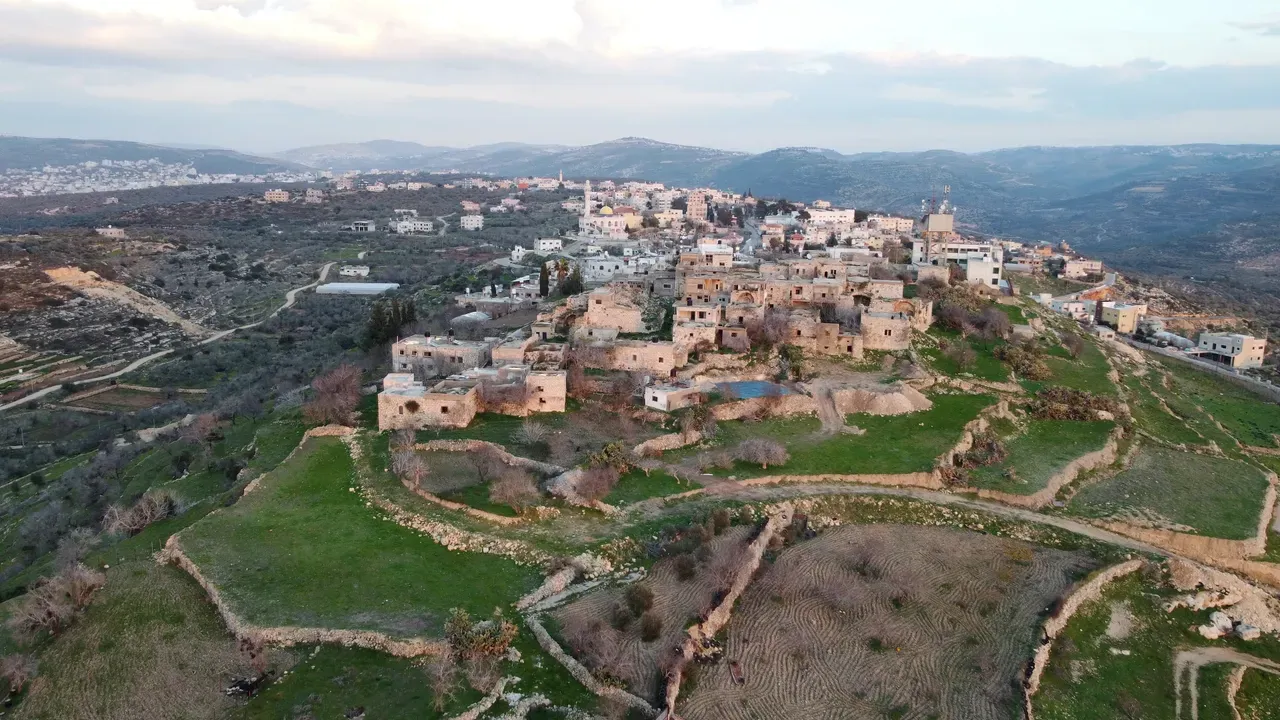
Reviving Farkha's Historic Old Town
Protecting land also means protecting the stories, architecture, and cultural identity that give communities their roots.
Since 2021, members of The Land Is Ours Volunteer Cooperative have partnered with local architects, heritage specialists, the Farkha Village Council, Al-Badd Cultural Center, volunteers, and international supporters to launch a long-term initiative to revive Farkha's historic Old Town.
The initiative began with community consultations, architectural surveys, documentation of historic buildings, and the development of a strategic restoration plan in collaboration with architecture students and heritage experts. It has also created opportunities for children and young people to reconnect with their village through cultural activities held inside the historic neighborhood.
Today, thanks to donations from friends, activists, and solidarity networks in Australia, we are completing the restoration of one of the historic houses in the Old Town.
This house will become Farkha Children's Cultural Center a permanent community space where children can learn about Palestinian heritage, participate in arts and educational activities, hear local stories from older generations, and strengthen their connection to their land, culture, and identity.
The center is expected to open in August 2026 and will become the first step in a broader community-led vision to gradually restore the historic neighborhood through volunteerism, local participation, and international solidarity.
For us, restoring a historic house is not simply preserving stones. It is preserving memory, identity, and the living relationship between people, culture, and the land they continue to protect.
Other Initiatives
To confront these challenges, the village launched various collective initiatives, such as:
- Fencing approximately 110 dunums of agricultural lands surrounding the old town area and located on “al Jiza” the hill facing the village.
- Protecting “Badran” the 2nd water spring water spring by fencing it, fixing the stairs and bringing electricity with the participation of more than 100 volunteers, and by organising visits there to ensure a presence.
- Organising a volunteer work festival in August in the last 30 years with both local and foreign volunteers, aiming to strenghten the (international) solidarity and bring more visibility.
- Organising solidarity presence during the olive harvest season, especially on the lands surrouding the new outpost.
These lands historically served as the village’s food basket and grazing area. Protecting and cultivating these lands collectively helps ensure:
- Long-term agricultural sustainability
- Strenthening farmers resilience in the face of settelment expansion and occupation policies.
- Protection of farmers’ livelihoods
- Food sovereignty
- Community resilience and connection to the land
Our Vision
We believe that collective farming, ecological agriculture, volunteerism, and local solidarity are essential tools for strengthening Palestinian resilience and preserving the relationship between people and land.
Through community participation and practical action, we are building a living model of resistance through agriculture, self-sufficiency, and cooperation.
Our team
Abdullatif
Admin
Mostafa B Hamad
Admin