



About
A Wireless Clock System Provides Versatility

A clock system, either hospital wall clocks cordless or wired, can be implemented for any organization and is versatile to a wide range of applications. We select to concentrate herein on wireless executions for reasons discussed listed below, yet both structural bases do the job. The essential attribute is synchronization of otherwise disparate features, boosting performance and establishing brand-new advancements.
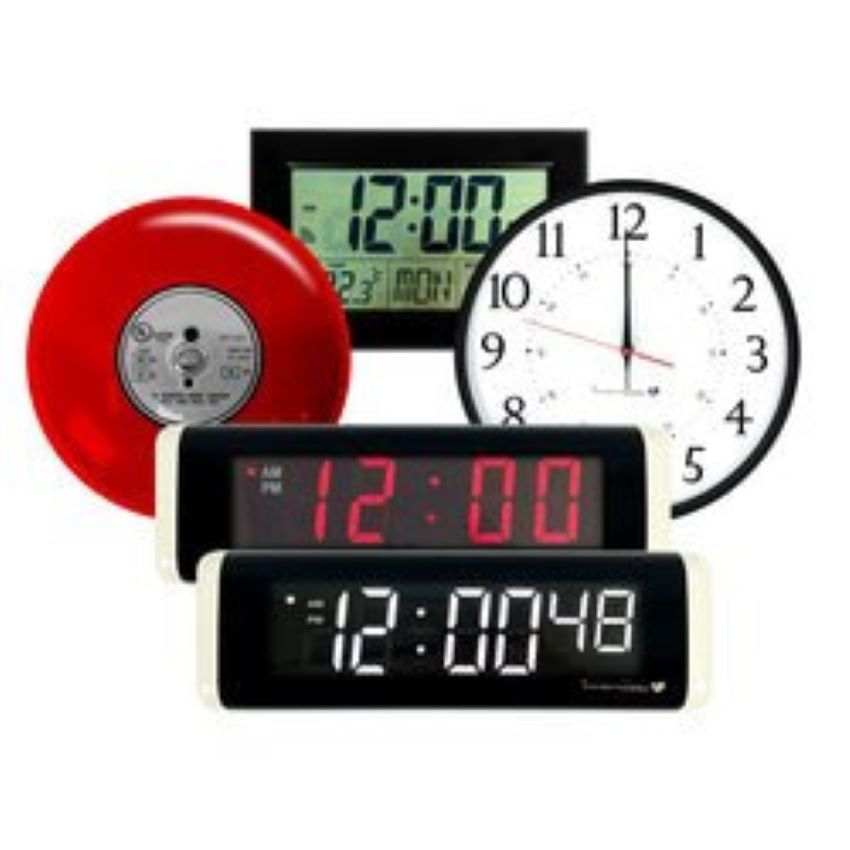
Commonly there is at the very least one outer tool established to interact with staff members and sometimes customers concerning events or news. This can take the distinct kind of a tone (or collection of tones), a bell, a whistle, or a buzzer to reveal breaks, shift changes, or-- when it comes to a school-- class adjustments. It might likewise take a visual kind, perhaps a message board, that might provide longer-term information.
By linking these gadgets right into the clock system, the audible ones can be made to appear, and the aesthetic ones to update, automatically according to a well-known timetable. For this to work, there needs to be a centralized master clock and a method to broadcast a signal to every dispersed (servant) wrist watch and tool at the same time. The nature of the signal is the moment itself or a coded message.
At the receiving end, the gadget requires the capability to "listen to" the signal and react accordingly. The response could be as straightforward as resetting the gadget's record of time (i.e., integrating to the master) or to communicate in some manner, with making a noise and/or aesthetically. In some systems it may be preferred for the peripheral device to recognize to the master invoice of the message.
Broadcasted signals are sent out over some type of transmission channel. If hardwiring is made use of, a center or cables fundamentally emit outward from the master and end at a specific dispersed clock or tool. Conversely, the signal can be transmitted wirelessly.
For a pair reasons, wireless approaches have a tendency to be chosen, at the very least nowadays. Initially, hardwired facilities has a non-negligible setup price as well as a regular upkeep expense, whereas wireless expenses are fairly a lot less to set up and maintain.
Secondly, laying cables is instead troublesome in terms of needing to avoid entrances and paths and other devices. In addition, the network is hard to update, fix, or change, and it is certainly not modular or portable. Wireless clock systems do not have any one of these troubles.
Indeed, organizations that go wireless often tend to have even more functional procedures and versatility. For instance, though connecting with all workers at once is an essential function, effective local interaction between a few workers can assist optimize procedures and create efficiency to climb. Synchronized signaling aids help with one group to hand off a partially completed product to an additional without either team having to await the other.
Healthcare facility processes depend greatly on synchronization to ensure exact records. Patients usually relocate from ward to ward, being seen by a varied team of registered nurses and physicians, and each caretaker needs to trust the information on the individual's chart, including the moments when drugs were provided or the time when food was last consumed. Because everyone's time is integrated to the very same requirement, regardless of proximity to or get rid of from the master clock, the chance of making a timing mistake is substantially minimized or removed.
To sum up, every service will profit from running a tight ship the methods of which promote both administration and employee jobs and aren't a detriment to their connections. Synchronization improves the precision of metrics, which in turn promote productivity and development. This is just how a wireless clock system gives flexibility.
Our team
Synchronized ...
Admin