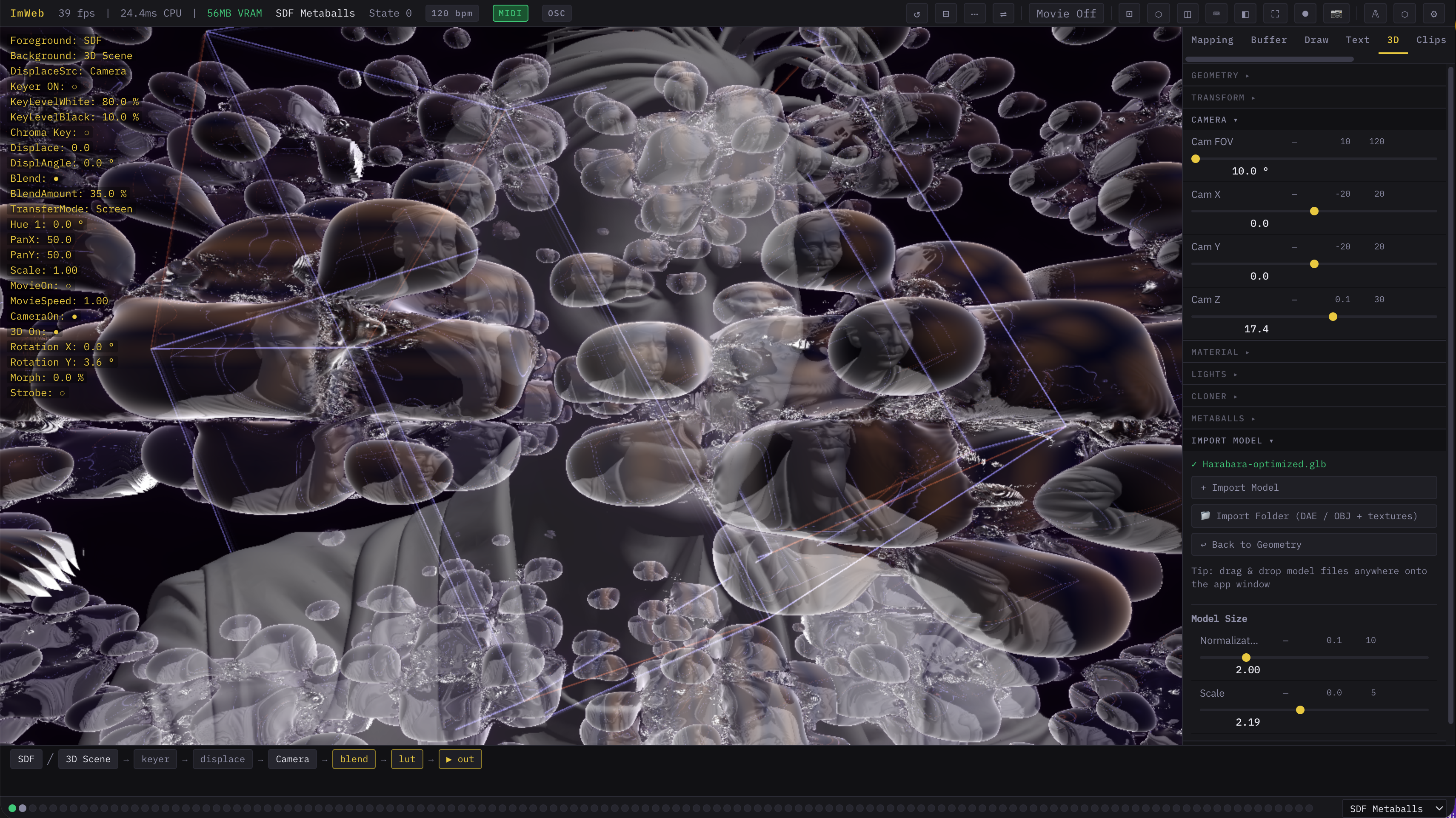
ImWeb is a browser-based real-time video synthesis instrument. No installation. No subscription. Open source, free for every artist on this planet, forever.
ImWeb is meant to be a joy to play. It is one instrument at every scale — a laptop on a kitchen table, a gallery installation running for a month, a stage with MIDI controllers and a projector. No install, no subscription, no separate professional edition. Whatever you can reach, you can play with.
What it does
ImWeb routes live video through a compositable signal chain — camera, dual movie decks with an unlimited clip library, 3D scenes, GPU particle systems, SDF raymarched metaballs, a Rutt-Etra scan processor, slit scan buffers, analog TV simulation, draw and text layers, noise, stills, and sequencers — combined through three mix buses and controllable in real time through an integrated controller system: MIDI, LFO, mouse, audio FFT, beat detection, random, and expression formulas. Every parameter is mappable. Every mapping is live.
The effects chain covers displacement, performative warp drawing, keying (including motion-extraction and chroma key), blending with decay, RGB channel delay, color shift, 3D LUT grading, kaleidoscope, bloom, interlace, pixel sort, film grain, and more, plus a master bypass and a live GLSL editor for writing your own. Output goes to fullscreen, a second monitor with projection mapping, or a WebM recording. The interface is also the performance — there is no edit/perform split.
And now it makes sound. ImWeb has always been able to listen — audio driving the picture through FFT and beat detection. It now works in both directions. There is a tape to record onto, scrub and play back at any rate including backwards; a spectral writer that renders whatever the instrument is showing into audio, with brightness becoming amplitude and height becoming pitch, quantised to a musical scale; a corpus view that measures the tape into grains and plots them by loudness, brightness and pitch, so you find a sound by touching a pad rather than scrubbing for it; and a granular player reading from wherever you touch. Colour in the picture decides stereo position. And because this is a feedback instrument, the signal path draws the closed mic → tape → speakers → mic loop when the room makes one — something you can see rather than something you discover at volume.
Built with Three.js, Vite, raw WebGL shaders and an AudioWorklet engine. No framework dependencies. Nothing between the artist and the signal.
Recent releases
ImWeb ships fast — four releases in the eleven days to 15 August 2026, and currently at v0.20.0, "The Other Half," which added the audio engine. Before it: "The Chain" (reworked effects chain and master bypass), "The Way In" (a guided tour parsed live from the manual), and "The Second Pair of Hands" (the controller layer — slew curves, very slow modulation, and controller menus reachable on any trackpad). Full history in CHANGELOG.md.
Where it is headed
ImWeb is in rapid development, and the roadmap follows what artists actually ask for. Next: multi-quad projection mapping with independent sources per quad, a multi-camera workflow, live GPU performance profiling, and a community preset library — the things that make bigger installations and longer runs practical. What exists today is already a capable touch-and-mouse instrument, soak-tested on real hardware. It is not the destination.
The lineage
ImWeb continues the work of Image/ine — the real-time video synthesis instrument built by Tom Demeyer at STEIM Amsterdam in the 1990s, developed in close collaboration with Steina Vasulka, one of the founding figures of video art.
But Image/ine had siblings in that building, and ImWeb is picking up more than one of them. LiSa — Michel Waisvisz and Frank Baldé, from 1995 — made live sampling a performance act: audio recorded into memory mid-set and played back in many directions, speeds and patterns at once, under sensor control, with the keyboard-sampler paradigm thrown out entirely. RoSa, Baldé's successor to it, went further: one big sample buffer reached through zones — recording, playback, load — so new material could be captured into the buffer while other zones were still playing from that same region, the whole thing driven over OSC with the interface left to whatever client you liked.
That is not an influence, it is the architecture. ImWeb's tape, its partitions, and its Recording and Playback Zones are RoSa's vocabulary, and its scrubbing and granular playback come from LiSa rather than from any DAW.
The wider family is a century of ideas that never went mainstream and never stopped being interesting. Drawn sound — Norman McLaren scratching optical soundtracks directly onto film, the ANS photo-electronic synthesizer, Xenakis's UPIC (1977), later Metasynth — all of them saying a picture can be a score. Video synthesis as an instrument rather than an effect: the Rutt-Etra scan processor (1972), the Paik-Abe synthesizer, and the Vasulkas building their own tools because nothing existing would do what they wanted. Corpus-based synthesis from IRCAM, where you find a sound by its qualities rather than its position on a timeline.
ImWeb has a Rutt-Etra processor, a spectral writer that turns the picture into sound on a musical scale, and a corpus you navigate by touch. None of those ideas is new, and the project does not claim them. What is new is the coupling — one gesture acting on a video warp and an audio navigation at the same time, in one runtime, live, on an instrument whose drawing surface and controller layer already exist and are already played.
There is a personal version of that claim. In around 2002 I performed with Image/ine on one machine and SuperCollider on another, code snippets resident simultaneously, each with its own fader. Nothing broke — the two machines were a CPU constraint, and I was the only link between the domains. ImWeb is that link built into the instrument.
None of this was ever mainstream. That is not the same as it being obsolete, and it is not a reason it should cost money or need an operating system that no longer ships.
Who built it
ImWeb was created by Haraldur Karlsson — Icelandic multimedia artist, researcher, and STEIM resident (2002, 2005, 2009). He used both ImOs9 and ImX extensively in his own performance and installation practice. Tom Demeyer came to Iceland University of the Arts to teach his own experimental software work; Steina Vasulka joined the Image/ine workshops there to help and inspire. In March 2026, Tom offered hosting at imweb.image-ine.org. This is not a detached restoration effort — it comes from inside the lineage.
How funds are used
Contributions pay for the time it takes to keep building ImWeb — new features, bug fixes, documentation — and for the small costs of running it: hosting, test hardware, software licences. Every payout is public on this page. At checkout, the Open Collective tip is optional; you can set it to 0. As the community grows, a transparent microgrant program — modeled on Hydra's community fund — will award small grants to artists creating original work, tutorials, or extensions with ImWeb.
Every contributor is listed here permanently. Supporting ImWeb means keeping a professional-grade audiovisual synthesis instrument free for every artist on this planet — student, veteran, or someone who has never heard of Image/ine but will build something extraordinary with it. You become part of that lineage.